National Portfolio Day NYC: Insider Guide for Families and Art School Applicants
By Dr. Nell Daniel, Former Director of Admissions at Parsons School of Design and Trustee of the Rhode Island School of Design (RISD)
Introduction
There are very few moments in the college application process where students can sit face-to-face with the people who may later review their applications and hear, in real time, what their work communicates. National Portfolio Day is one of those rare moments.
Each year, thousands of students gather their sketchbooks, digital portfolios, and courage and head into the cavernous halls of the Javits Center to show the work they’ve created, to learn what matters, and to understand what schools are truly looking for.
I’ve stood on both sides of the table at these events: as the Director of Admissions at Parsons, as a reviewer at the RISD booth, and now as a portfolio coach who helps students prepare for this day long before they ever step into the building. What I saw this year at National Portfolio Day in New York City reminded me why this event can be transformative—and why it can also be overwhelming without the right preparation. I cordially invite you to pick my brain on how RISD portfolio requirements actually work.
As you plan ahead for National Portfolio Day 2026 (dates not yet announced, but typically in late October), this guide will help you understand what the day feels like, what reviewers look for, what to avoid, and how to make sure your student gets the most out of the experience.
What National Portfolio Day Actually Is
National Portfolio Day is not a college fair. It is not an audition. It is not an interview. It is an educational event created by the National Portfolio Day Association, designed entirely around the development of young artists.
At its core, NPD is a space where students meet representatives from accredited art and design colleges—RISD, Parsons, SVA, Pratt, SAIC, MICA, and many more—to receive direct, honest, constructive feedback on their work. No one is there to sell you anything. No one makes admissions decisions that day. The purpose is learning and growth.
Who the Event Is For
While seniors often attend because deadlines feel close, NPD is actually most beneficial for sophomores and juniors. They have the runway to absorb feedback, experiment, revise, and grow—often dramatically—before senior year.
Parents also attend in large numbers. Many feel relief after speaking with admissions representatives, especially when they finally understand what portfolios should look like and what their child needs to work on.
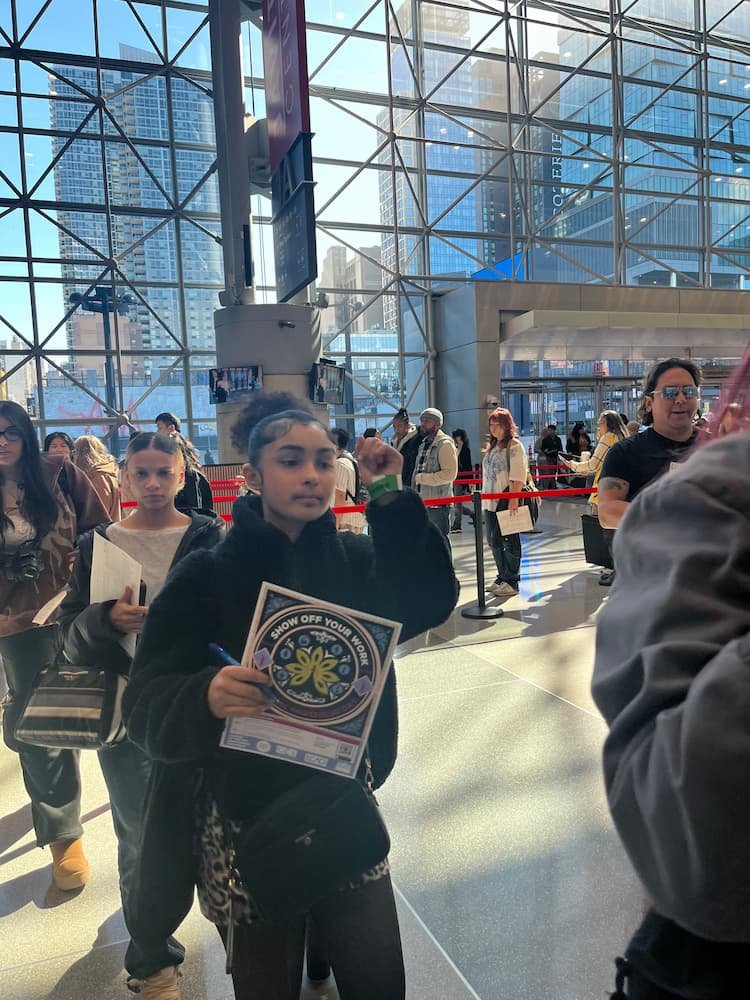
National Portfolio Day at the Javits Center, with multiple schools reviewing portfolios at once.
Inside the Javits Center: What the Day Feels Like
If you’ve never attended, imagine walking into a vast convention center filled with long rows of tables, each marked by a college banner. There are hundreds of students, all carrying portfolios in different forms: a laptop under one arm, a sketchbook tucked into a tote bag, occasionally a full sheet of Bristol board held flat between two hands.
The space hums with energy—antsy students glancing at their work one last time, parents scanning the room, reviewers leaning forward to get closer to a sketchbook page or monitor. The lines at popular schools form quickly. RISD, Parsons, and Cooper Union often have 30–40 students waiting at any given time.
The mood isn’t competitive in the traditional sense, but it is charged. Students want to be seen. They want direction. They want to know where they stand.
And woven through the crowd are the reviewers—admissions professionals and faculty members who have spent years evaluating portfolios. They sit behind simple folding tables, fully aware of the weight this moment carries for the teenagers waiting in line.
What Happens When You Sit Down for a Review
When it’s finally your turn, the interaction is simple: You sit down. You open your portfolio. You breathe.
You present your work—ideally your strongest and most recent pieces—and the reviewer begins talking. Some will ask questions right away. Others will quietly flip through your images or sketchbooks, gathering their impressions before speaking.
A typical review lasts 10–15 minutes.
What the reviewer is trying to understand is not merely what you can “do” but how you think, what you notice, what interests you, and how you approach the creative process.
What Reviewers Look For
Although every school has its own language and priorities, certain qualities matter everywhere:
• Observation: Drawing or working from life, not from photographs.
• Composition: Awareness of space, tension, scale, and visual choices.
• Risk-taking: Willingness to experiment, try new materials, or pursue ideas you haven’t fully mastered.
• Process: Sketchbooks, rough studies, iterations, and visual research.
• Originality: Work that comes from your thinking, not borrowed styles or trends.
• Recent development: Schools care more about where you’re going than where you started.
A strong portfolio isn’t a collection of finished pieces—it is a record of artistic thinking.

The RISD booth at National Portfolio Day, one of the busiest tables in the hall.
What I Observed at the RISD Booth This Year
The RISD booth is always one of the busiest at National Portfolio Day, and this year was no different. I reviewed work from a wide range of students—many of them thoughtful, dedicated young artists who simply haven’t yet been shown what college-level expectations look like. Several themes came up repeatedly, and each one represents an opportunity for growth rather than a shortcoming.
1. A strong emphasis on technical rendering
Many students showcased highly detailed, realistic drawings, which speaks to real commitment and discipline. What I encouraged them to consider is that technical skill is only half of what makes a portfolio compelling. Colleges are equally interested in the idea behind the work, the questions the student is exploring, and the choices they make as they move through the creative process. When technical ability is paired with conceptual intention, the work becomes far more powerful.
2. Compositions that could be pushed further
I saw many beautifully executed pieces with subjects placed directly in the center of the page. This is extremely common for high school artists, and it reflects where most students naturally begin. The exciting part is that composition can evolve quickly with guidance. Once students start experimenting with scale, cropping, and the use of negative space, their work gains a level of sophistication that reviewers immediately notice.
3. Comfort with familiar materials
Students often brought work made in the mediums they know best—pencil, charcoal, Procreate—which is completely understandable. What I encouraged, gently and often, was the value of trying something new. Colleges love to see curiosity in action: mixed media, unexpected combinations, material studies, experiments that didn’t go as planned but taught the student something meaningful. A little risk-taking goes a long way.
4. Process work that deserves more visibility
Sketchbooks were present, but many students tucked them away or treated them as secondary. In reality, a sketchbook is one of the most revealing components of a portfolio. It shows how a student thinks, how they problem-solve, how ideas emerge and evolve. When students bring forward their studies, notes, and iterations, the review conversation becomes richer and more personal.
5. Work influenced by popular styles
Some portfolios included stylistic influences from anime or social media trends. It’s very normal for students to absorb what they love visually. My suggestion was simply to treat these influences as starting points—not destinations. The students who begin exploring their own ideas, even in small ways, often make the fastest progress because they're building toward an authentic artistic voice.
Every one of these themes is completely normal at the high school level. In fact, National Portfolio Day exists precisely so students can learn where to stretch next. Families often tell me afterward that this was the first time they understood how achievable “college-ready” really is. With time, structure, and thoughtful guidance, students grow quickly—and often far beyond what they imagined possible.
How to Prepare for National Portfolio Day
-
Students often panic in the week leading up to NPD, trying to “fix” their portfolio at the last second. But the truth is, this event is not about perfection—it is about clarity. Start preparing early so you can curate your work thoughtfully.
Think about selecting a range of pieces: observational drawings, conceptual work, experiments, mixed media, sketchbook pages, and projects that show how you develop an idea. Arrange them so the reviewer can see evolution, not just completion.
Professional-quality photos of your work make a real difference. Natural light, neutral backgrounds, and consistent framing help reviewers see your work accurately.
-
Make sure your digital portfolio opens offline. I’ve seen so many students rely on WiFi at Javits, only to watch their images load slowly or not at all.
Practice articulating your ideas out loud. Not a script, not a speech—simply the ability to walk someone through your decisions. Students who can talk about their work clearly often receive more specific and actionable feedback.
Plan your travel, your timing, and what you’ll wear. You will be standing for hours. Comfort matters.
-
Bring your digital device, sketchbooks, chargers, water, snacks, and a notebook for recording feedback. Bring one or two small originals only if they can be handled easily without risk of damage. And bring confidence—not in the sense of bravado, but a willingness to hear feedback with openness and curiosity.
How to Navigate the Event Strategically
When families walk into NPD without a plan, they often spend most of their time waiting in the wrong lines. Start by identifying your top three schools. Visit them first. Lines move faster at smaller schools, so plan to fill gaps in your schedule with those tables. After each review, step aside and write down what you heard. Not everything will be comfortable to hear, but it will be useful. Look for recurring themes—those are the areas worth focusing on next.
Most important: avoid comparing yourself to other students. You will see extraordinary work, and you will see work that seems behind. That is not the point. The point is understanding your next step.
After the Event: Turning Feedback Into Growth
National Portfolio Day is only valuable if you act on what you learn. Within 24 hours, review your notes and highlight the guidance that appeared multiple times. Within a week, create a clear plan: what to make next, what to revise, what to remove. Within a month, you should begin to feel momentum—new ideas, stronger decisions, clearer goals. For many students, this is where coaching becomes transformational. Not because they lack ability, but because having steady, experienced guidance helps them translate feedback into real progress.
If you want a deeper view into how a portfolio should be structured across the entire application season, see our guide on how to create an art portfolio for college.
A Note for Parents
For parents, the event can be disorienting. You’re navigating long lines, absorbing unfamiliar terminology, and witnessing the staggering range of talent in the room. It’s natural to wonder whether your child is competitive or on the right track. Here is what I want you to know: Portfolio strength is not fixed. It develops through time, structure, and honest feedback. Students who start with modest work but take feedback seriously often surpass students who began with more natural ability but less openness to growth.
Your role is not to judge your child’s work, but to help them absorb this day with perspective. This is one moment in a long creative journey. Art school admissions reward evolution, not perfection.
Working With a Portfolio Coach vs. Relying on NPD Alone
National Portfolio Day provides breadth: quick feedback from multiple schools and a sense of the competitive landscape. But it cannot provide depth. Reviewers do not have time to go through your work-in-progress, discuss your artistic narrative, or help you plan your next ten pieces. Ongoing portfolio coaching offers what NPD cannot: structure, accountability, conceptual development, and a consistent relationship with someone who understands admissions at the highest levels.
Most of the students I’ve seen succeed at top-tier schools combine both experiences: they attend NPD for broad feedback and work with a coach afterward to refine their work strategically.
If your child wants to build a portfolio that demonstrates both technical skill and authentic conceptual depth, I would love to help. I work with students from 9th through 12th grade and specialize in preparing applicants for RISD, Parsons, Cooper Union, and competitive scholarship programs.
“What you have done for our daughter in such a short time is extraordinary. Her confidence and conceptual thinking have both expanded, and for the first time she actually understands what schools want to see.”
National Portfolio Day is an opportunity—not a verdict. It gives students a clearer view of their strengths, their gaps, and the direction their work needs to evolve. With the right preparation and willingness to learn, it becomes a turning point that shapes not only their portfolio, but their confidence as artists.
This article is part of our series on admissions preparation for art and design applicants. You may also want to read Personal Statement for Art School: Examples & Guide and Scholarships for Art School: Guide to Financial Aid and Merit Awards.
